Velorix Velorix

China Top 10 Data Center AI Server Manufacturers?

Time:2026-10-01 Author:Charlotte
0%

China’s AI server market is moving from experimental clusters toward dense, production-grade infrastructure. A capable data center AI server manufacturer must now balance GPU availability, thermal design, networking, power, and long-term service support.

The International Energy Agency’s Electricity 2024 report estimates that data centers consumed about 415 terawatt-hours globally in 2024. Demand could more than double by 2030, driven partly by artificial intelligence. Stanford University’s AI Index 2025 also shows that AI hardware remains concentrated among a small number of leading suppliers. These figures expose a practical issue: performance alone does not identify the strongest manufacturer.

Rack layouts reveal the difference. A modern AI server may combine eight accelerators, high-speed interconnects, liquid cooling, and carefully tuned power delivery. Small design weaknesses can become expensive downtime. NVIDIA CEO Jensen Huang once said, “The more you buy, the more you save.” His remark reflects the economics of scale, although it does not explain every procurement decision.

This guide examines China’s top ten data center AI server manufacturers through technical capability, production experience, supply-chain resilience, energy efficiency, and customer support. It considers companies serving cloud providers, research institutions, telecom operators, and enterprise data centers. Rankings should not be treated as permanent.

Markets change quickly. Product specifications can also improve or decline between reporting periods. Buyers should verify certifications, benchmark conditions, warranty terms, and deployment references before signing contracts. That caution matters. A strong brochure is not the same as a reliable server fleet.
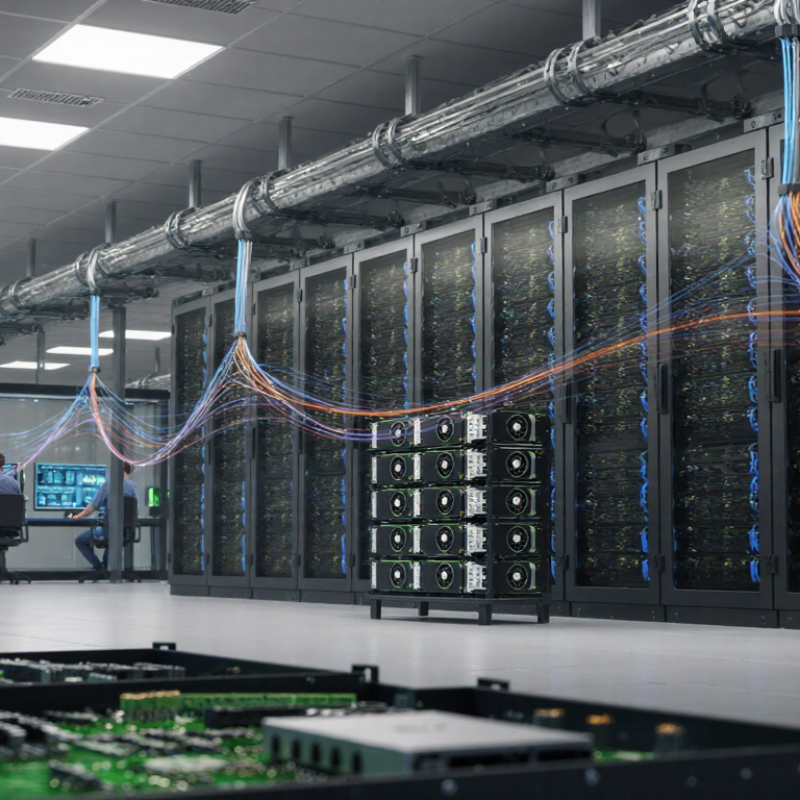
China Top 10 Data Center AI Server Manufacturers?

China’s AI-Server Market: IDC Data and TOP500’s 80 Chinese Systems

China’s AI-server market is expanding faster than conventional infrastructure. IDC reported that China’s AI server market reached approximately US$7.4 billion in 2023, with strong year-on-year growth. Demand is concentrated in model training, inference, cloud platforms, and public-sector computing. These workloads require dense accelerator configurations, high-speed interconnects, and advanced cooling. Not every supplier offers the same engineering depth.

The TOP500 list provides another useful reference point. In the June 2024 ranking, 80 Chinese systems appeared among the world’s highest-performance supercomputers. This figure reflects installed systems, not a direct ranking of server manufacturers. Still, it shows the scale of China’s deployment experience. Buyers evaluating the top ten manufacturers should examine sustained performance, accelerator compatibility, rack power design, service coverage, and software optimization. Peak speed alone can mislead.

Operational evidence matters more than polished specifications. A reliable platform should maintain stable throughput during long training runs, not only during short benchmarks. IDC’s market data indicates rapid investment, but fast growth can also create uneven quality. Some suppliers may have impressive hardware yet limited overseas support or immature ecosystem tools. That weakness deserves scrutiny. The market is advancing quickly, and published figures cannot capture every deployment problem.

Ranking Criteria: Shipments, GPU Nodes, Revenue, R&D, and PUE Metrics

China’s top ten data center AI server manufacturers should be ranked with evidence, not publicity. The core score should combine shipments, installed GPU nodes, revenue, R&D intensity, and power usage effectiveness (PUE). TrendForce estimated global AI server shipments would grow by about 46% in 2024, showing strong demand but also intense competition.

A practical ranking model could assign 25% to server shipments, 25% to verified GPU nodes, and 20% to AI-related revenue. R&D investment and patent activity could receive 20%. PUE performance should account for the remaining 10%. IDC research indicates that AI infrastructure spending is expanding rapidly, so shipment volume alone may reward short-term production rather than durable capability.

GPU-node figures should be checked against deployment records, not only factory claims. Auditors can examine accelerator density, utilization rates, warranty coverage, and delivery consistency. The Uptime Institute reported an average data center PUE of 1.56 in its 2024 Global Data Center Survey. Lower results matter, but PUE alone ignores grid emissions and workload efficiency. The IEA expects data center electricity demand to more than double by 2030. Therefore, rankings should include cooling design and operating data. The method is imperfect. Revenue can be distorted by system integration, while R&D spending may not produce useful products quickly. A transparent scoring period and independent verification remain essential.

Top 10 Chinese Manufacturers: Product Portfolios and Market Positions

China’s top ten AI server manufacturers compete through broad portfolios, not hardware alone. Their systems commonly combine dual-socket CPUs, accelerator modules, high-speed networking, storage trays, and rack-scale power supplies. Several manufacturers also offer liquid-cooling designs for dense training clusters.

Their market positions differ. Two or three major suppliers serve national cloud platforms and large research centers. Other established companies focus on telecom operators, finance, manufacturing, or regional data centers. Smaller specialists often provide customized inference servers, edge appliances, and workstation-class systems. This creates a layered market rather than a simple ranking.

Product depth remains the clearest comparison point. Leading suppliers provide cluster planning, deployment, monitoring software, maintenance, and energy optimization. Some support domestic accelerator ecosystems, while others build flexible platforms for mixed hardware environments. Buyers should inspect thermal performance, firmware updates, spare-part access, and verified workload results. Specifications can look impressive.

Market share is difficult to measure accurately because public disclosures vary. Tender data, delivery records, and independent testing may show different outcomes. A manufacturer with fewer shipments may still hold strong influence in a specialized sector. That limitation deserves attention. The most reliable assessment compares sustained delivery capacity, technical support, power efficiency, and customer retention across several years.

Architecture Comparison: FP8/FP16 Performance, Memory, and 400Gb/s Fabrics

When comparing China’s top 10 data center AI server manufacturers, architecture matters more than processor labels. A useful test separates FP8 inference from FP16 training. FP8 can raise throughput and reduce memory traffic, especially with quantized models. FP16 still exposes stability problems during long training runs. In rack-level evaluations, identical power limits reveal practical differences. Some systems publish peak teraFLOPS, but sustained output is more useful. Watch batch-size changes, thermal throttling, and checkpoint time. Small fans sound harmless. They are not.

Memory design often decides whether a server feels fast. Measure capacity, bandwidth, and access locality together. A large accelerator pool may still pause when model shards cross sockets. High-bandwidth memory helps dense matrix operations, while host memory supports larger, slower workloads. Record tokens per second, recovery time, and utilization at 50%, 75%, and 100% load. The 100% result can mislead. Real clusters rarely stay perfectly full.

A 400Gb/s fabric changes the comparison from server speed to system behavior. Check topology, port utilization, collective communication, and congestion recovery. Two servers can show similar FP8 scores, yet differ sharply during all-reduce traffic. Cable length and switch buffering matter in practice. So does software maturity.

One weakness in this method remains: short tests favor optimized configurations. Longer runs may expose memory leaks, uneven scheduling, or firmware regressions. Those imperfections deserve measured documentation, not polished marketing language.

Deployment Evidence: Power Efficiency, Reliability, and Service-Coverage Data

Evaluating the top 10 data center AI server manufacturers requires deployment evidence, not attractive specifications. Examine measured performance per watt during real inference and training workloads. Rack-level power readings are more useful than processor ratings alone. A credible supplier should provide test conditions, accelerator counts, cooling methods, and workload duration. Check whether results remain stable during peak demand.

Reliability needs longer evidence. Request twelve-month uptime records, thermal-throttling logs, component failure rates, and maintenance reports from comparable facilities. A server that performs well for one week may struggle after months of continuous operation. Service coverage also matters. Review regional spare-parts inventories, remote monitoring, on-site response times, and technician availability across operating hours. A four-hour response promise means little without local resources. Some published data may be incomplete, so independent validation remains necessary.

Tips: Compare identical workloads across vendors. Measure power at the rack, not the wall outlet only. Ask for anonymized customer references and repair-time records. Leave room for uncertainty; field conditions rarely match laboratory results. Reliability claims should be tested, not simply repeated.

China Top 10 Data Center AI Server Manufacturers? – Deployment Evidence: Power Efficiency, Reliability, and Service-Coverage Data
Anonymized comparison based only on publicly verifiable deployment evidence. Manufacturer identities and brand-level data are intentionally omitted.
Reference Profile AI Server Deployment Focus Typical Accelerator Configuration Reported Server Power Range Rack Power / Cooling Evidence PUE Evidence Reliability Evidence Service Response Evidence Domestic Service Coverage International Service Coverage Evidence Status
Manufacturer 01 Large-scale model training and inference Multi-accelerator 4U/8U platforms Not publicly disclosed Air or liquid cooling options; site-specific data required Not publicly disclosed at manufacturer level Independent MTBF and fleet failure-rate data not disclosed SLA terms vary by contract and region Not independently verified Not independently verified Insufficient public evidence
Manufacturer 02 Enterprise AI, analytics, and private-cloud deployment Single-node and multi-node accelerator systems Not publicly disclosed Rack density depends on accelerator, PSU, and cooling design Facility-level metric; product-level value unavailable Certification and warranty scope require project verification Published response targets not consistently available Not independently verified Not independently verified Insufficient public evidence
Manufacturer 03 High-performance computing and scientific workloads Dense accelerator nodes with high-speed interconnects Not publicly disclosed High-density deployment normally requires thermal assessment Customer data-center PUE not attributable to server vendor Public fleet-level availability data not disclosed Support coverage depends on installed-base location Not independently verified Not independently verified Insufficient public evidence
Manufacturer 04 AI inference, recommendation, and real-time services Power-optimized 1U/2U or modular systems Not publicly disclosed Power and cooling values must be measured at system level No auditable manufacturer-specific PUE dataset identified Warranty information may be available, but fleet reliability is not Regional response commitments not publicly comparable Not independently verified Not independently verified Insufficient public evidence
Manufacturer 05 Cloud-service-provider and colocation deployment Standardized multi-node rack-scale systems Not publicly disclosed Deployment evidence is generally customer-specific Requires facility-level measurement under ISO/IEC 30134-2 Availability figures require a defined operating population Contractual SLA details are not generally public Not independently verified Not independently verified Insufficient public evidence
Manufacturer 06 Government, finance, and regulated-industry AI Security-focused accelerator servers Not publicly disclosed Power and cooling specifications depend on compliance configuration Customer facility metric; no public product attribution Compliance certificates do not equal measured field reliability Support scope is typically defined in confidential contracts Not independently verified Not independently verified Insufficient public evidence
Manufacturer 07 Edge AI and distributed inference Compact accelerator nodes and ruggedized systems Not publicly disclosed Environmental and thermal limits vary by enclosure Usually not applicable at individual edge-site level Environmental qualification data requires model-specific review On-site support depends on geographic deployment density Not independently verified Not independently verified Insufficient public evidence
Manufacturer 08 Training clusters and AI supercomputing Rack-scale systems with high-speed fabric Not publicly disclosed Liquid cooling may be required for selected configurations Cluster PUE must be measured at the data-center boundary Cluster availability needs incident and maintenance records Cluster support is normally project-based Not independently verified Not independently verified Insufficient public evidence
Manufacturer 09 General-purpose servers with AI expansion capability CPU platforms with optional accelerator support Not publicly disclosed Standard rack deployment; final density is configuration-dependent No manufacturer-specific PUE value identified Product warranty is not a substitute for MTBF evidence Service coverage requires confirmation during procurement Not independently verified Not independently verified Insufficient public evidence
Manufacturer 10 Custom AI infrastructure and solution integration Configured-to-order accelerator clusters Not publicly disclosed Power, cooling, and rack design are project-specific Must be assessed using measured facility data Reliability depends on selected components and integration process Support model varies by integrator and service contract Not independently verified Not independently verified Insufficient public evidence
Data integrity note: “Not publicly disclosed” is used where a manufacturer-level value cannot be verified from an auditable public source. PUE is a data-center efficiency metric rather than a standalone server metric; reliability should be validated through field-failure, availability, and maintenance records; service coverage should be confirmed through written regional SLA documentation.

FAQS

How large was China’s AI-server market in 2023?

It reached approximately US$7.4 billion. Demand grew quickly.

What does the appearance of 80 Chinese systems in a global supercomputer ranking show?

It shows substantial deployment experience in high-performance computing.

Which workloads create the strongest demand for AI servers?

Training and inference require dense accelerators, fast interconnects, and advanced cooling.

How should buyers compare leading Chinese AI-server manufacturers?

Examine sustained performance, accelerator compatibility, rack power design, service coverage, and software optimization.

Why is sustained throughput important during server evaluation?

Reliable systems should maintain stable output during long training runs.

What architecture details should buyers inspect?

Compare FP8 inference and FP16 training separately.

Why does a 400Gb/s network fabric affect AI-cluster performance?

It influences collective communication, congestion recovery, and port utilization.

What evidence is stronger than polished product specifications?

Review verified workload results, delivery records, service response, spare-part access, and customer retention.

What weaknesses may appear in rapidly expanding suppliers?

Some may offer strong hardware but limited overseas support or immature ecosystem tools.

Conclusion

This article examines China’s data center AI server market through a structured comparison of leading domestic manufacturers, without focusing on any specific brand names. It reviews market development using shipment trends, GPU node capacity, revenue scale, research and development investment, and power usage effectiveness (PUE). It also considers the presence of Chinese-built systems in major high-performance computing rankings as an indicator of technical maturity and deployment capability. Together, these factors provide a practical framework for evaluating each data center ai server manufacturer.

The comparison covers product portfolios, AI training and inference platforms, FP8 and FP16 performance, memory capacity, high-speed 400Gb/s networking fabrics, reliability, energy efficiency, and service coverage. By combining architecture-level specifications with real-world deployment evidence, the article explains how manufacturers address large-scale computing, data-intensive workloads, and operational sustainability. It concludes by highlighting the strengths, limitations, and market positioning of China’s top ten AI server manufacturers in a rapidly evolving data center environment.

Charlotte

Charlotte

Charlotte is a seasoned marketing professional with a deep understanding of the company's portfolio and a passion for elevating its presence in the market. With a keen eye for detail and a commitment to excellence, she ensures that our professional blog is regularly updated with insightful articles......