Velorix
AI demand is changing what buyers expect from a machine learning server manufacturer. A rack is no longer judged by processor counts alone. Memory capacity, accelerator availability, interconnect bandwidth, cooling design, and service coverage can shape real-world performance. IDC’s 2024 Worldwide AI and Generative AI Spending Guide projected global AI spending would reach $632 billion by 2028, including hardware, software, and services. That broad forecast is not a server-sales estimate, but it signals sustained investment in the infrastructure behind AI workloads. The stakes are tangible. For buyers, power draw and heat matter as much as peak benchmark scores.
In 2026, leading manufacturers will need to show how their systems handle training and inference, from compact deployments to dense GPU racks. NVIDIA CEO Jensen Huang said at Computex 2024, “The next wave of AI is physical AI.” His comment points to workloads that may connect models with sensors, machines, and real environments, increasing demands on compute and data movement. This guide compares manufacturers through practical factors: system configurations, accelerator options, thermal design, support, and deployment flexibility. No shortlist is perfect. Specifications change, regional availability varies, and published performance figures may reflect different test conditions. Treat comparisons as a starting point, then verify configurations and total cost against your own workload.
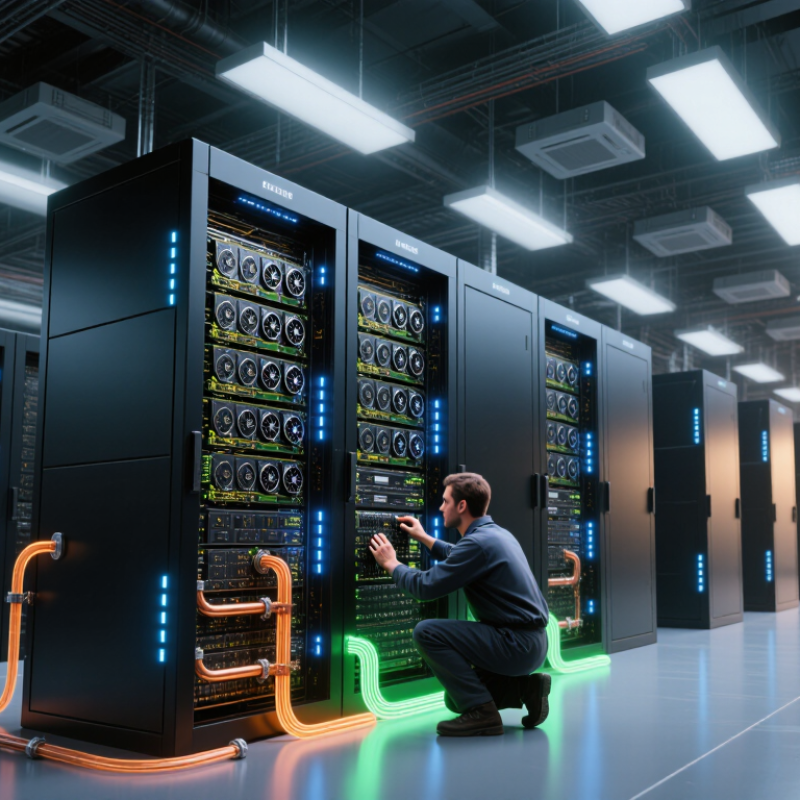
What defines a machine learning server in 2026 is sustained model throughput, not accelerator count alone. It needs enough high-bandwidth memory to keep large models fed, fast links between processors, and reliable networking across multiple machines. Storage matters too: slow data loading can leave expensive accelerators idle. A capable system balances compute, memory, networking, power, and cooling.
Performance claims need context. Stanford’s AI Index 2025 reported that inference costs for GPT-3.5-level performance fell more than 280-fold between November 2022 and October 2024. That makes efficiency increasingly important alongside raw speed. Uptime Institute’s 2024 Global Data Center Survey found average data-center PUE had remained around 1.58 for several years. In practice, a server’s heat output and power draw shape its real operating cost. The trade-offs are rarely neat.
Tips: Test your actual model and workload before choosing a configuration. Measure tokens per second, memory use, and performance under sustained load. Check rack power and cooling limits, too. A brief benchmark can mislead.
| Evaluation dimension | What defines it | Typical 2026 server characteristics | Why it matters |
|---|---|---|---|
| Accelerator capacity | The number and type of GPUs or other compute accelerators supported in one server. | Configurations range from one or two accelerators for development to four- or eight-accelerator systems for intensive training. Supported devices and quantities vary by platform. | Accelerator count affects parallel compute capacity, model size, throughput, power draw, and system cost. |
| Accelerator memory | On-device high-bandwidth memory (HBM), considered alongside how memory can be shared or accessed across accelerators. | Capacity depends on the accelerator generation and model. Large-model training often relies on multiple accelerators and distributed techniques when a model does not fit in one device’s memory. | Memory capacity can limit model size, batch size, and the amount of data processed at once; memory bandwidth affects data movement during computation. |
| CPU and host memory | Processors, system memory capacity, memory bandwidth, and the number of memory channels. | Multi-socket or high-core-count processors are common in compute-dense systems. Server memory is generally ECC-capable DDR5; capacity is selected to match data loading and workload needs. | The host prepares data, coordinates accelerators, and runs system services. Insufficient CPU or memory resources can leave accelerators underused. |
| Accelerator interconnect | The links that carry data among accelerators, such as high-speed direct links or PCI Express. | Interconnect design is platform-specific. Systems may combine accelerator-to-accelerator links with PCIe, using higher-bandwidth fabrics for tightly coupled multi-accelerator workloads. | Fast, low-latency communication helps distributed training scale, particularly when accelerators frequently exchange model or gradient data. |
| Network connectivity | Network adapter speed, port count, and support for Ethernet or InfiniBand-class fabrics. | Common deployment choices include 100, 200, or 400 Gb/s per high-speed port, with faster options available in some infrastructures. Aggregate bandwidth depends on port count and configuration. | Network performance affects distributed training, shared-storage access, and data transfer between servers. |
| Storage and data access | Local NVMe capacity and throughput, plus connectivity to shared or parallel storage. | Servers typically use NVMe solid-state drives for operating systems, caches, and staging data; dataset capacity may be provided by a shared storage system. | Storage that cannot supply data quickly enough can stall training. Capacity, throughput, and workload access patterns should be evaluated separately. |
| Power and cooling | Power delivery, thermal design, airflow, and support for air or liquid cooling. | High-density accelerator systems can require multiple kilowatts per server. Exact demand depends on components and workload; dense configurations may use direct liquid cooling. | Facility power and cooling capacity determine whether a server can be installed and operated reliably at its intended performance. |
| Chassis and serviceability | Rack compatibility, component access, expansion options, and the ability to maintain the system. | Rack-mounted designs commonly use standard data-center rack widths, while chassis height and depth vary. Accelerator systems may have limited expansion once fully populated. | Service access, cabling, rack space, and replacement procedures affect deployment time and ongoing maintenance. |
| Software compatibility | Support for operating systems, drivers, accelerator frameworks, containers, and management tools. | A suitable platform should document validated software versions and provide tools for monitoring hardware health, temperature, power, and utilization. | Compatible, maintainable software reduces deployment friction and helps teams diagnose performance or reliability issues. |
| Reliability and security | Error detection, secure boot and firmware controls, hardware monitoring, and documented support policies. | Evaluate ECC support where applicable, firmware update practices, component health reporting, warranty terms, and availability of replacement parts. | Training runs can last for days or longer; fault detection and dependable service help reduce downtime and protect data and infrastructure. |
| Workload fit and total cost | Measured performance for the intended workload, considered alongside acquisition, energy, networking, and support costs. | Compare systems using representative training or inference benchmarks, the required numerical precision, expected utilization, and the complete deployment configuration. | A larger accelerator count does not automatically provide better value. Workload-specific throughput and operating costs are more useful than peak specifications alone. |
Configuration ranges are indicative rather than universal. Actual specifications depend on the server platform, accelerator generation, workload, and data-center infrastructure.
Check accelerator compatibility, memory capacity, storage bandwidth, and support for your software frameworks. Processor counts alone can mislead.
Match the system to the workload. Training may need several accelerators and strong cooling, while inference may need more memory and predictable response times.
Use tests with similar models, datasets, software, and system configurations. Ask for completion times and measured throughput, not just headline figures.
Run your own models for an extended period. Record throughput, power draw, and accelerator temperatures. Keep the test practical.
Long jobs can produce sustained heat and power demand. Ask for measured figures under realistic workloads, not peak estimates. Heat matters.
Check response times, warranty terms, firmware updates, and replacement-part availability. Ask whether technicians can diagnose faults remotely.
Find the actual bottleneck first. Data movement, storage, or CPU performance may matter more than extra accelerators. I might still misjudge this.
Consider expansion, but base it on expected usage, rack space, cooling, and network limits. Workloads change; early estimates can be wrong.
In 2026, a machine learning server is defined not only by its processing power but also by how effectively it supports demanding workloads, from model training to inference. Comparing manufacturers involves looking at accelerator compatibility, memory capacity and bandwidth, storage and networking options, cooling and power efficiency, system reliability, and the flexibility to expand as needs change. Support, deployment services, and the ability to integrate with existing infrastructure also matter.
Leading machine learning server manufacturers take different approaches to performance and scale, balancing compute density, configuration flexibility, and operational efficiency. The right choice depends on the workload: large-scale training may call for high-speed interconnects and substantial accelerator capacity, while inference may prioritize throughput, latency, and energy use. Evaluating these factors together helps organizations select a platform that fits current requirements and can adapt to future growth.